
Discrete trial training, DTT, is the most recognizable teaching format in applied behavior analysis, and the most misunderstood. Its critics picture a child drilled on flashcards until the joy leaves the room. Its defenders sometimes teach exactly that way, which does not help. This guide covers what the format actually is, why it survived four decades of scrutiny, and the specific places a DTT program earns or loses its value.
The five parts of a DTT trial
A discrete trial is short, often under ten seconds, and has a defined beginning and end. That boundary is the point: it makes one learning opportunity, and one scored response, out of what would otherwise be an undifferentiated stream of interaction.
- The instruction: the material or request the child should respond to — a sample to match, a word to find. It should be clean and consistent, without a running commentary around it. Calling it “the discriminative stimulus” is a simplification worth flagging in match-to-sample: what the child actually discriminates between is the sample against the comparison array, not the sample alone, so the array is part of what controls the response too.
- The prompt, when one is needed: whatever help is arranged so the child responds correctly — a faded distractor, a gesture, a model. Not every trial carries one; an independent response has none. In an errorless arrangement the prompt is present from trial one and withdrawn on a schedule.
- The response: one observable behavior, defined in advance, so that scoring it is not a judgment call.
- The consequence: reinforcement for a correct response, a neutral correction for an error. What exactly follows correct-but-prompted responses is its own decision — see the differential-reinforcement note below.
- The inter-trial interval (ITI): a short pause that separates this trial from the next. It gives the consequence room to register and marks the boundary the next instruction starts from.
Every part is a place programs quietly diverge. Two instructors can both say they “run DTT” and deliver different instructions, different prompt schedules, different consequences and no ITI at all, which is why fidelity checks matter as much as the format.
Figure — One discrete trial, part by part
Trial begins
-
Instruction
The material or request the child responds to — a sample to match, a word to find.
The decision: Is it clean and consistently delivered, or wrapped in commentary that changes?
-
Prompt (optional)
The help arranged when the child needs it to respond correctly: a faded distractor, a gesture, a model. Absent once a response is independent.
The decision: Present on a written schedule and withdrawn by a fixed criterion, or improvised when it looks hard?
-
Response
One observable behavior, defined before the session starts.
The decision: Could a second person score it the same way without asking you?
-
Consequence
Feedback, correction and reinforcement are three different things: feedback says right/wrong, correction is the procedure after an error, and reinforcement is what follows a correct response and is meant to make it more likely again.
The decision: What follows a correct-but-prompted response — the same reinforcer, or less?
-
Inter-trial interval
A short pause that closes this trial before the next instruction opens the following one.
The decision: Is there one at all? Without it the boundary the format depends on disappears.
Trial ends · one scored response
Massed or interleaved?
The oldest DTT drills presented one target over and over — ten trials of “dog”, then ten of “cat”. Massed practice looks efficient and produces something worse than inefficiency: a child who answers “dog” because the last nine answers were “dog”, not because of the picture in front of them. That is recitation, not discrimination.
Interleaving mixes targets within the session, which closes off answering by streak alone — it does not, by itself, force the child to actually look at each sample, and it does not guarantee generalization on its own either; both still depend on the rest of the trial being run well. It can cost more errors early, though not always, and the trade is meant to buy discrimination that holds rather than recitation. Modern practice interleaves by default and reserves brief massed blocks for the very first exposures to a new target, if it uses them at all. That said, “always interleave” is not a universal rule either: with a completely new target, or with a child who dysregulates when things vary, a short block at the start is a defensible decision. What does not hold up is a whole program built on long blocks.
The three classic criticisms — and what a good program does about them
“It produces robotic responding.” It does when the instruction never varies and the reinforcer is delivered identically every time. The fix is planned variation: different exemplars of each concept, varied phrasing where the program allows it, and reinforcement that thins as competence grows rather than staying mechanical forever.
“It creates prompt dependency.” It does when prompts are withdrawn late, inconsistently, or without a criterion. The fix is a written fading schedule: an explicit advance criterion, an explicit regress rule after errors, and, crucially, full reinforcement withheld from prompted responses only after the child has shown they can respond independently, never from trial one.
“It doesn’t generalize.” It doesn’t when every trial uses the same picture on the same table with the same adult. The fix is built-in variation of exemplars and probes with material the child has never been trained on — untrained exemplars answered correctly are the actual evidence that a concept, rather than a picture, was learned.
Most of what gives DTT a bad name traces to programs that keep the structure and drop the discipline behind it — but not all of it. Generalization in particular takes deliberate, ongoing probing even in a well-run program; a discrete trial format does not generalize on its own just because the implementation is careful.
Why the structure is worth keeping
One scored response per trial is what makes DTT data usable. Percent correct, prompted versus independent responding, latency, errors by position — all of it exists because the trial has a boundary. Formats that feel more natural often measure nothing, and a program that measures nothing can only be steered by impression.
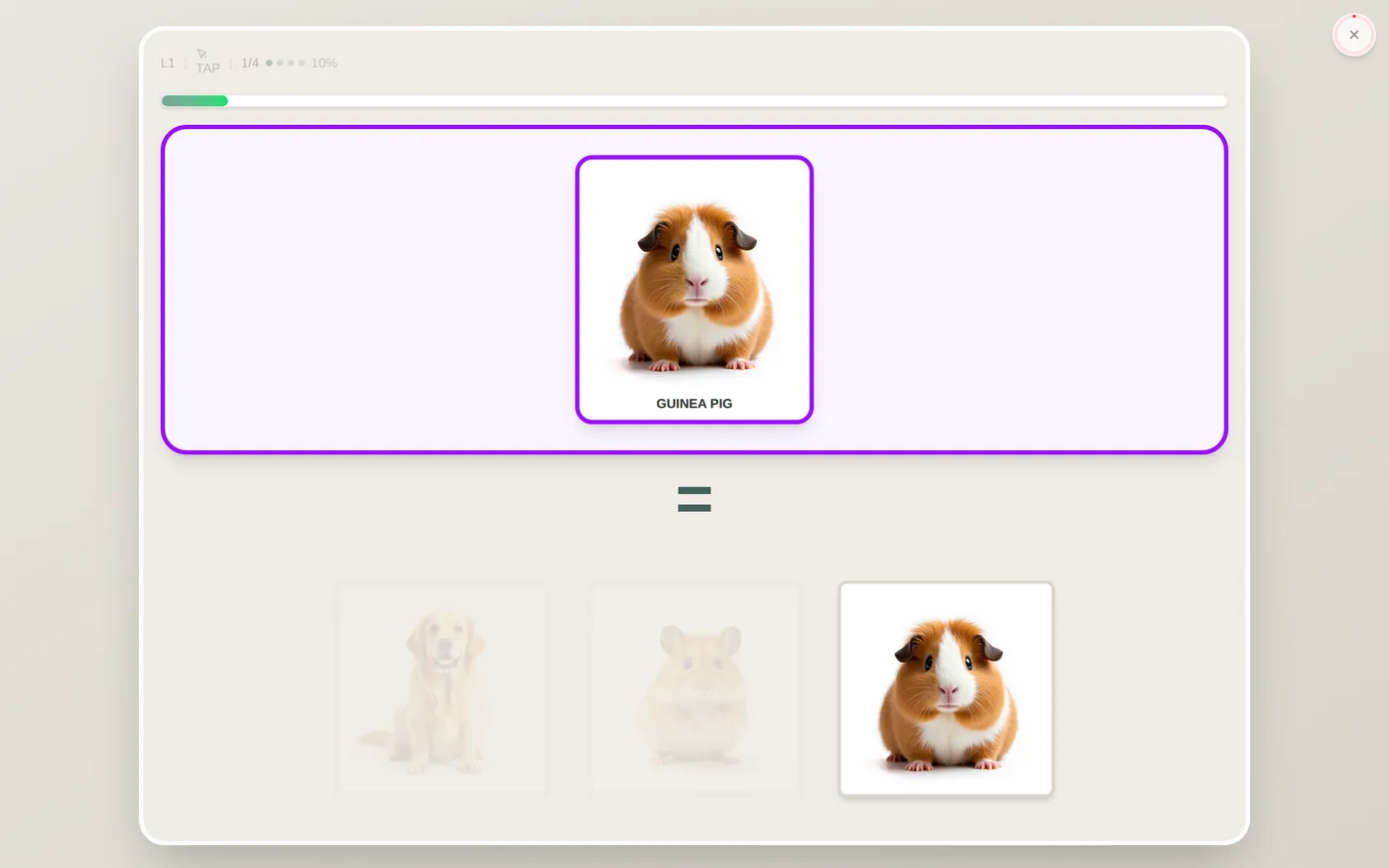
This is also where software genuinely helps. Interlaza runs match-to-sample programs in exactly this format: it interleaves targets across the session by default (an Instructor can choose massed or blocked presentation instead where that is the right call), fades its prompts on an explicit schedule with a regress rule after errors, holds reinforcement thinning until an independence criterion is met, applies a configurable inter-trial interval, and records every trial — response, prompt level, latency — without the instructor writing anything down. The format is the same one in the literature. What changes is that none of it depends on remembering the schedule while a child is waiting.
Further reading
- Smith, T. (2001). Discrete trial training in the treatment of autism. Focus on Autism and Other Developmental Disabilities, 16(2), 86–92.
- Lovaas, O. I. (1987). Behavioral treatment and normal educational and intellectual functioning in young autistic children. Journal of Consulting and Clinical Psychology, 55(1), 3–9.
- Cooper, J. O., Heron, T. E., & Heward, W. L. (2020). Applied Behavior Analysis (3rd ed.). Pearson.