
A family needs ten minutes that go smoothly with nothing to set up. An Instructor needs a record they can defend: what was taught, how much help it took, and whether it held up later.
Interlaza is built to give each adult the layer that belongs to their role, from one coherent learning record around the child.
For families: a clear next step
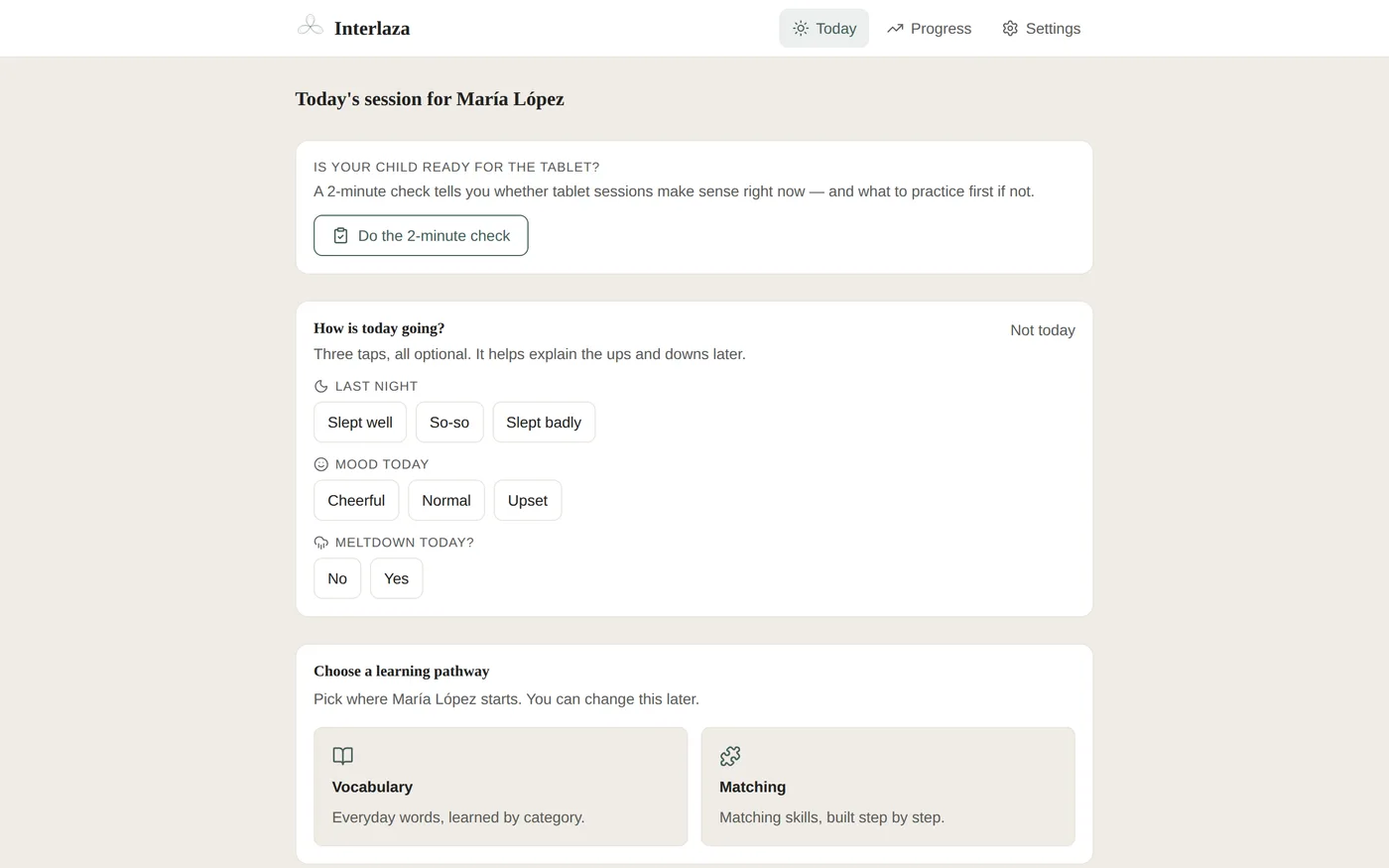
The Family experience opens on Today. The next session is prepared from the guided route, progress is summarized in plain language and settings stay out of the way.
A session that opens with a string of decisions — which activity, which images, how difficult, what counts as progress — costs more from the adult than the ten minutes it is meant to take. Interlaza reduces those decisions so the adult can stay close, observe and stop when the session is no longer useful.
For Instructors: structure without surrendering judgment
Professional work needs more than a colorful trial screen. Interlaza supports pathways, prompt records, concept-level histories, generalization probes — trials run with no help and no feedback, on material the child has not practised — and several forms of off-tablet measurement.
It also surfaces patterns that are easy to miss across hundreds of trials: a target that is taking longer to reach criterion, a procedure that is drifting, or a decision that has sat unresolved. The software can organize that evidence and suggest where to look. The Instructor decides what it means and what changes.
That boundary is deliberate. Interlaza is most useful when it removes clerical effort without pretending an algorithm knows the learner’s goals.
For neurodivergent learners: more than one way to participate
Not every child should be asked to work in the same sensory setting or through the same motor response. Sessions can use a tablet or physical materials. Celebrations can be calmer. Activities can be shortened. A learner who is not ready for on-screen matching can still participate in carefully recorded work away from the screen.
Accessibility here is the ability to change the conditions while preserving what the program is trying to learn, and not a special mode added after the product.
Measurement that follows the question
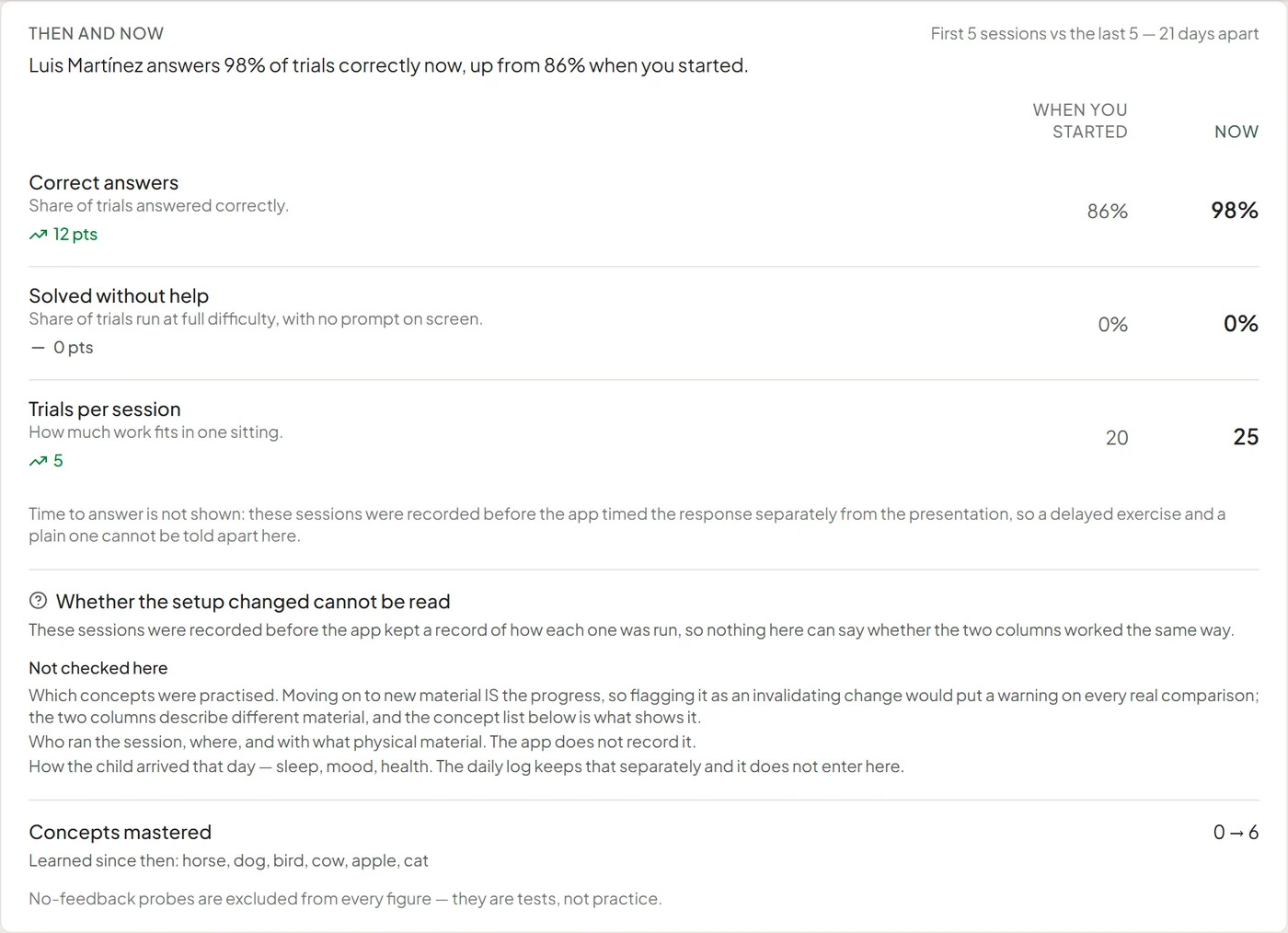
A discrete match can be scored trial by trial. A freely occurring vocalization needs a count and an observation window. A behavior that lasts needs duration. Supported practice should not quietly become independent evidence.
Interlaza keeps those distinctions because a dashboard is only helpful when unlike sessions do not collapse into one attractive but meaningless percentage.
- Compare equivalent opportunities
- Read accuracy and help separately
- Keep the limitations of the records visible
Bilingual by design
The interface, guidance and teaching content are available in Spanish and English. Programs can relate spoken words, written words, pictures and real objects across languages while keeping teaching and emergence checks distinct — a real object is something an adult presents by hand in an off-tablet session, not something the tablet itself displays. What a family can do bilingually is set by the guided route; an Instructor can build and adjust bilingual pathways directly, and custom probe authoring is available in Researcher and Institution workspaces.
That does not turn bilingual exposure into an automatic intervention. It does solve a concrete problem: bilingual families no longer have to choose between using the language of home and using the language their software understands.
What Interlaza does not promise
Interlaza does not diagnose, replace an Instructor or certify that a child has “learned” from a single score. It records what happened, applies configured rules and makes the next question easier to see.
That is the point of the whole design: you do not have to choose between a tool that feels simple and a record you can defend.