Search for ABA therapy activities and you will get lists — fifty ideas, a hundred, sorted by age. Lists are the easy part. What almost none of them say is the part that decides whether an activity teaches anything: how you run it.
ABA is not a therapy, even though nearly everyone calls it one — and the phrase above is the one people type into a search box. ABA is an applied science, applied behavior analysis, and the activities below are its teaching procedures rather than treatments.
The same ten minutes with the same cards can be a teaching session or a pleasant way to pass the time. The difference is not the material.
What turns an activity into teaching
Four things, and they are all small:
One clear request. The child should know what is being asked without a running commentary around it. “Give me the apple” beats “OK sweetie, now look, can you find the one that’s the same, the apple, where’s the apple?” — the second buries the instruction in eight other words.
Help that is there from the start and then leaves. The most common mistake is to let the child guess first and correct afterwards. An error is not neutral information — letting a child get it wrong gives them a chance to practice the wrong answer, which is one reason many programs prefer to prevent errors before they happen. Make the first attempts almost impossible to fail, then withdraw the help so gradually they do not notice.
A consequence that the child actually wants. Praise works for some children and is noise for others. Whatever it is, it arrives immediately and it is worth working for.
Something written down. Not a research protocol — a tally. Without it, “he’s doing better” is a feeling, and feelings about a child you love are not a measure.
Four activities that need almost nothing
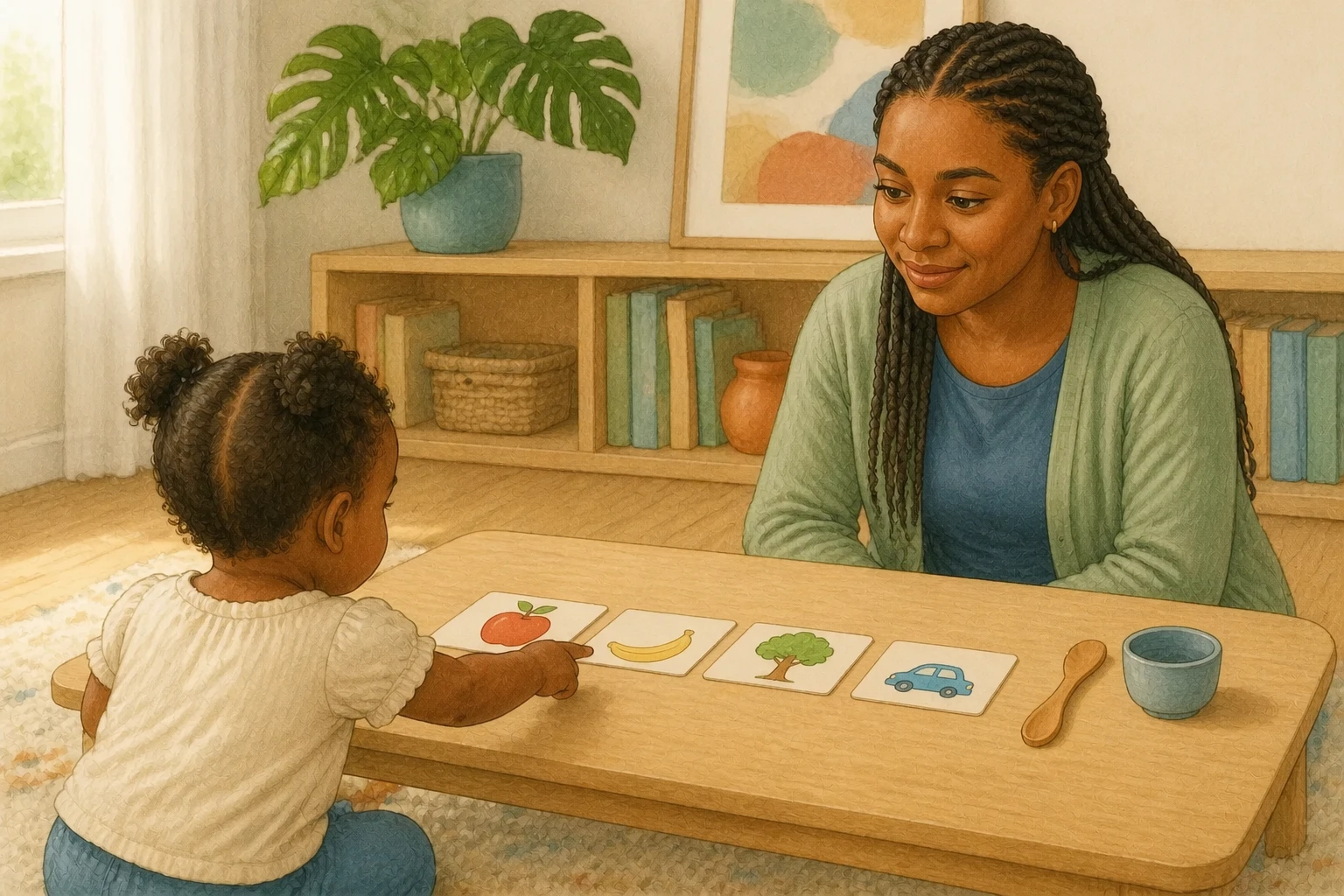
Matching. Two identical pictures, one shown and one to find. It is often where families start, and it lines up with something simpler underneath: before a child can link a word to an object, it helps if they can already tell one thing from another and see that two things go together. It needs two copies of three or four pictures and nothing else.
Sorting. The same idea, one step up: a pile of items and two boxes. Animals here, food there. It works with real objects, which is an advantage — spoons and socks are already in the house.
Requesting. The child asks for something they want, in whatever form they have: a word, a sound, a point, a picture handed over. This is the one activity where the reward is not arbitrary, because getting the thing IS the consequence. Put a preferred item in view and slightly out of reach and wait a beat before helping.
One-step instructions. “Sit down.” “Give me the cup.” “Touch your nose.” Short, one action, no chain.
Most of what fills the hundred-item lists is a variation of one of these four, or a game built on top of one.
Figure — Four activities, four aims
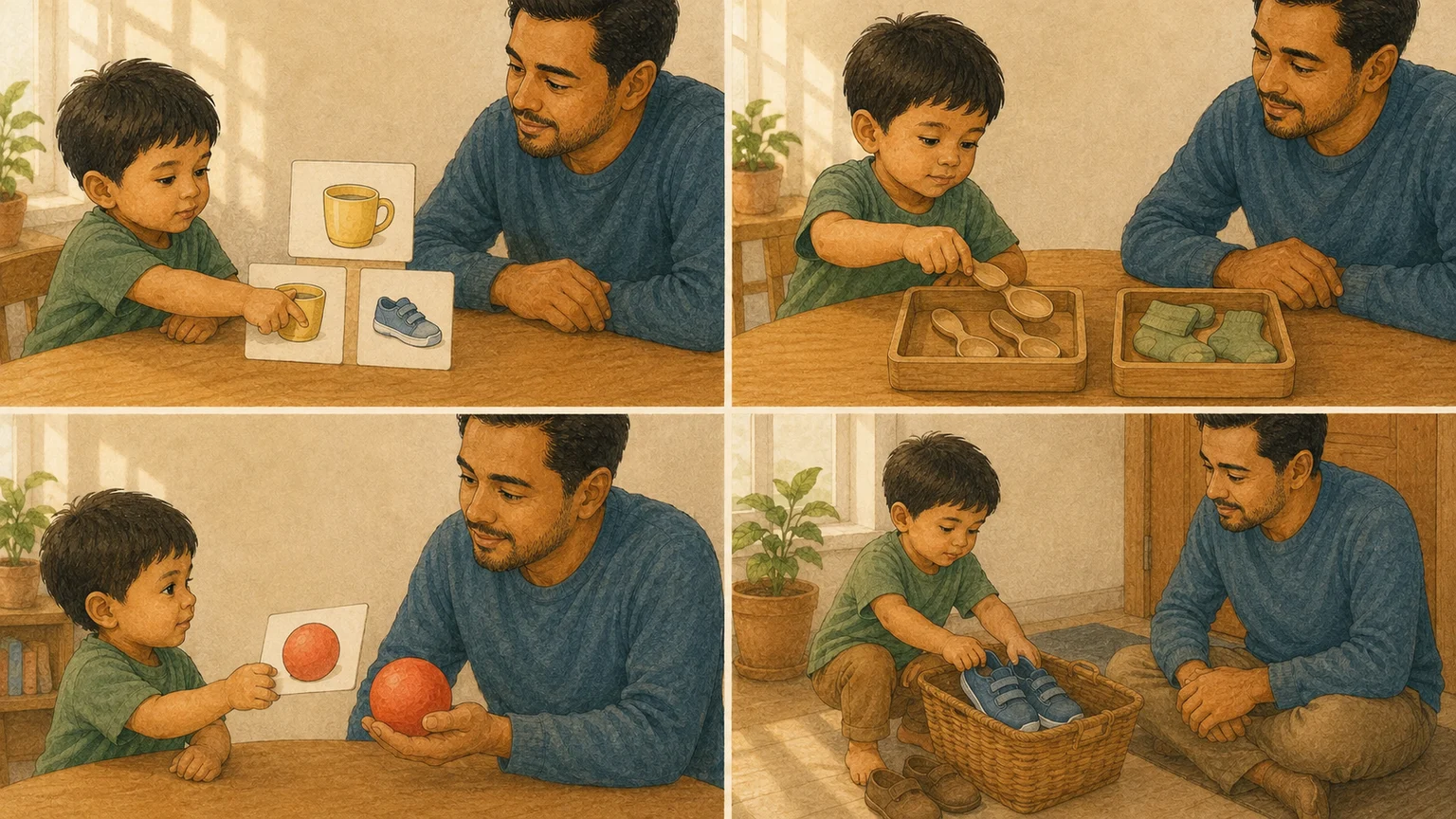
- Match pictures
- Group objects
- Ask for something
- Take part in a routine
How to pick today’s activity
Start where the child already succeeds and move one notch. One example of a progression: if matching two identical photos is easy, try matching a photo to a drawing of the same thing, and after that a spoken word to a picture — though the right next step depends on the child, not on this specific order. If a step produces errors, you moved too far — go back one and come forward more slowly. Difficulty is not the only thing worth weighing: whether the child is genuinely interested in the material, whether you actually have it on hand, and whether the child is regulated enough to engage all matter too.
The test is not whether the activity looks advanced. A child getting almost everything right on something slightly too easy is still learning; a child getting less than half right, session after session, on something that looks impressive is mostly practicing failure.
The part almost every list skips
An activity that works inside the session and nowhere else has not finished teaching. The skill has to appear with a different adult, in a different room, with a different picture of the same thing — otherwise the child has learned this card on this table, which is a real thing to have learned and not the thing you wanted.
So the check is cheap: as a rough rhythm — once a week is a reasonable starting point — ask for something you taught, somewhere you did not teach it, with no help at all. What happens then is the actual result.
And be clear about what a matching score proves. A child who matches pictures reliably has shown they can tell those things apart and pair them — that is receptive discrimination, and it is worth having. It is not evidence that they understand the word, or that they will use it.
Further reading
- Our readiness check — three questions, one minute, no signup — for whether tablet-based practice suits your child right now.
- Ten well-spent minutes, a real home session step by step.